
Planting Seeds in the Desert: Interviews with Legal Oasis Interns (Part 9)

In this blog post series, interns who are participating in the Legal Oasis Internship program discuss their participation in the program and why they choose to live and serve in an underserved area. Background on this program can be found in the initial blog post of this series. It is our hope that others will be inspired by these stories.
The post in this series is an interview with Steven Jacobs, a 2L at Elon University School of Law.
The interview was conducted by James S. Perry, a small-town practitioner in Kinston. Mr. Perry is also on the Professionalism Committee with the NCBA and is currently the Executive Director of the Chief Justice Commission on Professionalism.
Steven Jacobs was born in Newport News, Virginia, but he calls Eastern North Carolina home. At Elon, he serves as president of the Federalist Society. He is a lover of dogs, good food and warm weather.
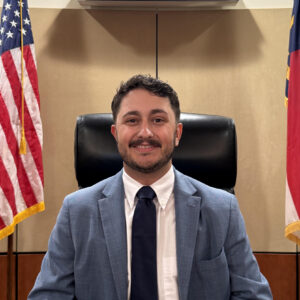
Steven Jacobs
Could you share about your background?
My name is Steven Jacobs, and I am a rising 2L at Elon University School of Law. I was born and raised in Newport News, Virginia. I have a labrador and border collie mixed dog named Cora who has helped me make it through many stressful times throughout my life (this is especially true since I’ve started law school). In 2014, I enlisted in the Virginia National Guard, later transferred to an Alabama unit and completed my service in 2020. I received my undergraduate degree at Auburn University (War Eagle) and finally moved back to North Carolina in 2025 to be closer to family.
Why have you decided to go to law school?
I have always felt a calling towards the service of others and feel that I am best suited to helping people through the legal profession. In my youth, I was able to witness so many struggles involving our legal system that everyday people go through. Those people may have been family, friends, neighbors or complete strangers, but a large majority of them all shared some common traits.
The first trait was that most people have little to no idea about how our legal system functions, what protection they may or may not have within that system and they generally may not even know where to start to look for the help they need. That’s okay though, because we don’t expect everyone without a law degree to have all the legal answers they need. That’s what lawyers are for. The second trait, and certainly the most alarming, was how most people could not afford the legal assistance that they needed, or they would’ve had to put everything they own on the line to afford it.
Again, I don’t think everyone needs to be taught civil procedure, torts or property law, but everyone does need easy access to affordable, competent legal assistance.
My family and my faith led me to decide that going to law school, returning to eastern North Carolina and helping its community through the court was the best way for me to give back to a community and nation that I love.
What do you hope your future will look like?
I don’t expect my future with law to be too glamorous or to be like a TV show. I don’t plan on chasing the big jobs in the large metro areas or applying to any large firms around those areas. All I hope for is that I can make a meaningful difference in people’s lives and then come home to a beautiful family every day so I can spend time with them.
Please describe what you’re doing this summer and what your experience has been like.
This summer, I’ve been working for Finch Legal, P.L.L.C., which is a general practice that serves eastern North Carolina. The lawyer who is mentoring me, Mitchell Finch, has used a quote a few times that really does encompass what being in general practice feels like. He always says, “Every day is like the Bar Exam,” which at first seems like hyperbole, but after a few weeks with him, I’ve been able to see how true that statement is. A lot of clients that we deal with have problems that involve classes that I haven’t even taken yet. So, it has involved some learning on the fly, deep legal research, as well as some quick emails to Mitchell when I’ve finally decided that I need help understanding what we’re doing or where we go next.
With that being said, I’ve loved every second of it and, if I could go back in time, I’d take this job every time. This internship is exactly what I need to prepare myself for my career.
How has your summer experience impacted your future plans?
Driving all around District 1 multiple times over this summer has taught me that I need to get a car with better gas mileage.
All kidding aside, this summer has solidified that this is where I’m meant to be, and this is what I’m meant to do. Though a lot of Dare and Currituck Counties are in a rural, “small-town” area, my summer experience has shown me I don’t have to choose between where I live, seeing friends and family or having a successful career. I can still be successful, live comfortably and where I want to, and I don’t have to be in a big city to do those things.
Describe the community you’re working in and if you feel like you’ve connected well with it through your experience.
I’ve mainly worked in Currituck, Dare and Pasquotank Counties. I thought I knew people around this area before, but I’ve been connected to so many great people who I likely would’ve never crossed paths with before. Additionally, I’ve had to learn about certain aspects of the law that I initially never would’ve seen myself doing, but all those things have grown on me and become part of what I want my professional footprint to be, while helping expand how I see the world and the law.
Would you encourage other students to participate in the Legal Oasis Internship?
Absolutely. I would recommend everyone to at least give it a shot, as it is an eye-opening experience. This internship can show anyone how private practices are helping the Public Defenders and the Courts keep the system functional and moving. If it were not for private practices helping with this load, then the system would be more overwhelmed than it already is and even more people would be essentially denied the legal access they need. Understanding this idea and then seeing what we as new lawyers can do to help would be beneficial for everybody involved.