
What Asheville Revealed About the Future of Legal Leadership

The future of legal leadership is not being shaped in isolation; it is being built in real time at the intersection of crisis response, community engagement and cross-sector collaboration. A recent gathering of young lawyers in Asheville offered a clear view of what that future looks like in practice and where the profession is headed.
In Asheville, young lawyers from North Carolina and Georgia convened for a cross-state program centered on networking, service and leadership development. Hosted across multiple venues, the program blended education, community engagement and collaboration across jurisdictions. More importantly, it demonstrated a shift in how legal leadership is developed: not through theory alone, but through direct exposure to complex, real-world challenges.
That shift was most evident in the program’s focus on leadership during crisis.

Leadership in Action: Crisis as a Defining Test
A central component of the program featured a joint Georgia CLE and North Carolina workshop with Asheville city leadership, focused on emergency management, infrastructure resilience and legal authority during crisis response. Discussions moved beyond doctrine and into execution: how decisions are made, communicated and implemented under pressure.
Participants explored emergency preparedness, infrastructure vulnerability, intergovernmental coordination, and the legal frameworks that govern crisis response. Just as critical was the evolving role of attorneys, not only as legal advisors, but as strategic partners in communication and decision-making.
Asheville Mayor Esther Manheimer emphasized both the complexity and visibility of crisis leadership, noting that “the public doesn’t always see the level of coordination and teamwork happening behind the scenes. Response efforts rely on strong partnerships, clear communication and quick decision-making under pressure.” She further underscored the leadership mindset required in these moments: it is critical “to remain steady, transparent and focused on supporting the community through both the immediate response and the recovery ahead.”
Her observations reflect a broader reality: in moments of disruption, leadership is not theoretical. It is operational, immediate, and highly visible.
That reality was reinforced by Asheville City Attorney Brad Branham, who underscored that “the role of an attorney is absolutely essential to governmental function during an emergency.” He emphasized that “well-reasoned and strategic legal counsel can mean the difference between effectively navigating a crisis and exacerbating the problems with missteps and legal challenges,” highlighting how attorneys guide both elected officials and operational staff through rapidly evolving situations. This framing makes clear that in crisis, legal judgment is not reactive; it is a driving force behind operational success.
Together, these perspectives point to a clear conclusion: the modern lawyer is not confined to interpreting the law after the fact. Increasingly, attorneys are embedded in the decision-making processes that shape outcomes in real time.
Service as a Foundation for Leadership
While crisis response highlights the lawyer’s role in moments of urgency, sustained leadership is built through service. The program’s pro bono component: a housing clinic conducted through Legal Aid of North Carolina’s “Lawyer on the Line” initiative demonstrated how service functions as both a professional responsibility and a leadership training ground.
Under the guidance of Supervising Attorney Lauren Ashley Wright of Legal Aid of North Carolina, participants worked directly with community members facing housing challenges. As she explained, these clinics help clients “gain a clearer understanding of their rights,” while volunteers “build confidence by working through real cases” with support and collaboration.
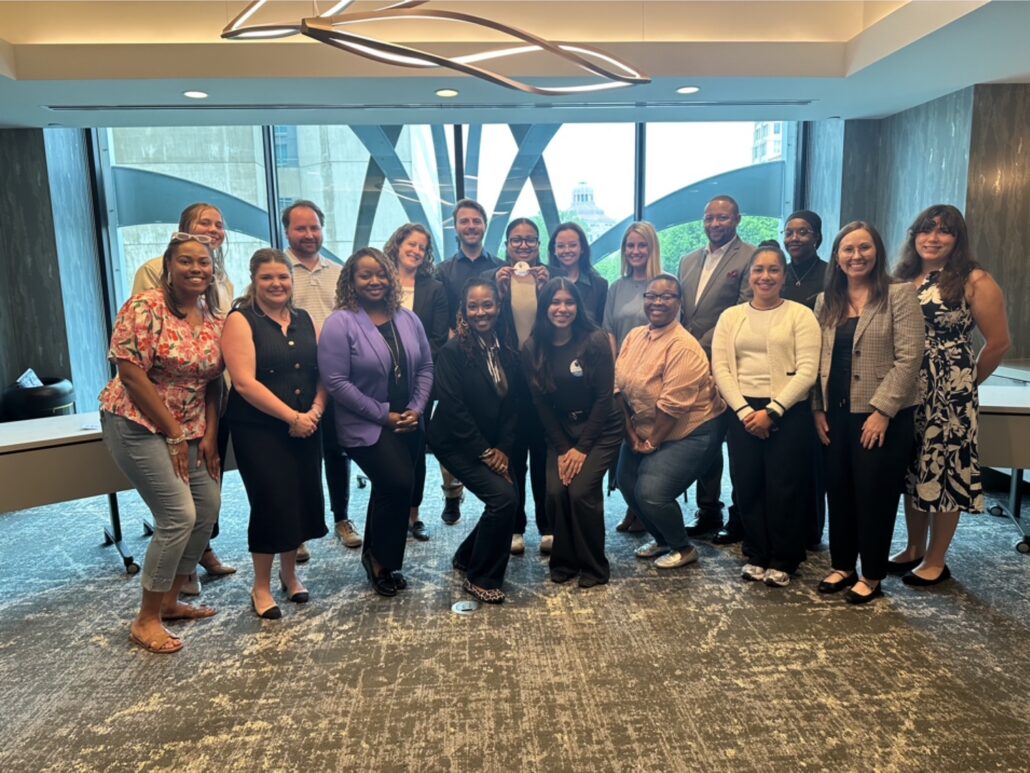
For participants, the experience reinforced how direct service shapes professional identity. Isabella Reed noted the impact of “hearing directly from members of the community who were experiencing housing issues,” grounding legal work in lived experience rather than abstraction.
That perspective was echoed by Cayla James, a YLD Pro Bono Leadership Cohort member from rural Appalachia, who connected pro bono service to broader structural need: “Coming from rural Appalachia, I know firsthand how scarce resources are, and how needed pro bono services are . . . Legal Aid NC provides a lifeline to those who would otherwise have nowhere else to turn.” Her reflection highlights the role of service not just as volunteerism, but as a critical component of access to justice in underserved communities.
Kaci Marks further captured the leadership dimension of this work, observing that pro bono initiatives “reinforce that legal leadership requires a commitment to service to maintain system accessibility for everyone.”
This is a critical point for the profession: leadership is not developed solely in boardrooms or courtrooms. It is forged through engagement with the communities the legal system is designed to serve.

Cross-State Collaboration and Expanding Perspective
The collaboration between the North Carolina Bar Association Young Lawyers Division and the Georgia Young Lawyers Division added another dimension to the program: perspective.
Veronica R. Cox, YLD President for the State Bar of Georgia, emphasized that the experience provided “fresh perspectives” and “a deeper understanding of how our neighbors respond to real-world crises.” Her reflection underscores the value of shared problem-solving across jurisdictions.
From the North Carolina perspective, NCBA YLD Chair Sheila Spence framed the collaboration within a broader professional goal: breaking barriers to access and opportunity. She noted that the program provided “practical tools in civic legal leadership during times of crisis” while reinforcing the lawyer’s role as “a bridge for the community.”
Exposure to different systems and approaches strengthens a lawyer’s ability to think critically, adapt quickly and lead effectively in complex environments.

The Role of Relationships in Leadership Development
Some of the most meaningful development occurred outside formal sessions. Informal gatherings, including a joint networking lunch and social events, created opportunities for connection across practice areas, experience levels and jurisdictions.
Cherell Harris reflected that the experience helped humanize public leadership, noting that elected officials are “real, approachable people—not the distant, untouchable figures so often portrayed.” That shift in perception matters, particularly for lawyers considering roles in public service or civic leadership.
Similarly, Shameka Rolla emphasized the long-term impact of these connections, observing that programming like this “helps shape the pipeline for future leaders” by expanding networks both within North Carolina and across state lines.
These moments are not incidental, they are foundational. Trust, familiarity, and professional relationships often determine how effectively lawyers collaborate in high-stakes situations.
Why This Matters Now
The legal profession is evolving. Lawyers are no longer defined solely by discrete roles as advocates or advisors. Increasingly, they are expected to operate as cross-sector leaders: professionals who can navigate crisis, engage communities and coordinate across institutional boundaries.
The Asheville program illustrates what effective leadership development looks like in this environment: it integrates education, service and relationship-building into a cohesive experience. It places lawyers in contexts where they must listen, adapt and respond — not just analyze.
If the profession is to meet the demands of the future, it must continue to invest in these models. That means prioritizing experiential learning, expanding cross-jurisdictional collaboration and recognizing pro bono service as central, not supplemental, to leadership development.
The next generation of legal leaders will not be defined by where they practice, but by how they lead: in moments of crisis, in service to their communities and in collaboration across sectors. Asheville did not just showcase that future. It made clear that it is already here.